AI-Accelerated Marketing: How We Cut Creative Production Time by 60% Without Sacrificing Quality
Six months ago, a luxury fashion client needed 40 creative variations for a major campaign launch. Our team estimated 12-14 business days from concept to final delivery, a timeline that would have missed their launch window. The client asked if we could expedite. We said yes, but honestly weren't sure how we'd deliver without compromising quality or burning out the team.
Today, that same scope takes us 4-5 business days, the creative is demonstrably better (both aesthetically and in performance metrics), and our team is less stressed, not more. The difference? We rebuilt our entire creative production workflow around AI-enhanced processes while keeping human expertise exactly where it matters most.
This wasn't about replacing our creative team with ChatGPT. It was about identifying the 60% of creative work that was purely mechanical, the grinding, repetitive tasks that consumed time without adding unique value, and automating those tasks so our team could focus on the 40% that requires genuine creative thinking, strategic insight, and luxury brand sensibility.
Let me show you exactly how we did it, what works, what doesn't, and why transparency about AI usage became our competitive advantage rather than something to hide.
The Creative Production Bottleneck (Before AI)
To understand the transformation, you need to see our original workflow. Here's what producing 40 ad variations for a campaign used to look like:
Day 1-2: Concept Development
Review client brief and brand guidelines (2 hours)
Competitive research and platform trend analysis (3 hours)
Brainstorm session with creative team (2 hours)
Develop 8-10 concept directions with rough positioning statements (4 hours)
Client review and concept selection (1 day turnaround)
Total: 2 days, 11 hours of team time
Day 3-5: Copywriting
Write 5-7 hook variations per concept (6 hours)
Develop body copy variations for each concept (4 hours)
Write CTA variations aligned to funnel stage (2 hours)
Internal copy review and refinement (3 hours)
Client review and revision (1 day turnaround)
Total: 3 days, 15 hours of team time
Day 6-9: Visual Development
Source or shoot photography for concepts (12 hours or 1 shoot day)
Develop layout variations for static ads (8 hours)
Create video storyboards and scripts (6 hours)
Design and produce video variations (16 hours)
Internal creative review (2 hours)
Total: 4 days, 44 hours of team time
Day 10-12: Revision and Finalization
Incorporate client feedback (8 hours)
Produce final variations across all formats (6 hours)
Platform-specific adaptations and sizing (5 hours)
Final QA and file preparation (3 hours)
Total: 3 days, 22 hours of team time
Overall Timeline: 12 business days Total Team Hours: 92 hours across 4 team members Cost Structure: ~$8,300 in labor at blended rates
And here's the critical insight: of those 92 hours, we estimated that only about 35-40 hours required specialized creative expertise that genuinely differentiated our output. The other 52-57 hours was mechanical execution—important work, but not uniquely valuable work.
The AI-Enhanced Workflow (Current State)
Here's that same 40-variation campaign scope in our current AI-enhanced workflow:
Day 1: Accelerated Concept Development
Review client brief and brand guidelines (2 hours - human)
AI-powered competitive analysis and trend synthesis (1 hour - AI + human review)
AI-generated concept directions based on brand guidelines and brief (30 minutes - AI)
Creative team refinement and strategic positioning (2 hours - human)
Client review and selection (same day feedback via async tools)
Total: 1 day, 5.5 hours of human time, ~3 hours of AI processing
Day 2: Rapid Copy Development
AI-generated hook variations aligned to concepts (15 minutes - AI)
Creative director review, refinement, and brand voice calibration (2 hours - human)
AI-generated body copy and CTA variations (15 minutes - AI)
Copy polish and strategic optimization (1.5 hours - human)
Total: 1 day, 3.5 hours of human time
Day 3-4: Accelerated Visual Production
AI-generated visual concept explorations (30 minutes - AI)
Photography direction and selection (2 hours - human, or AI-assisted image generation when appropriate)
AI-assisted layout generation for static variations (1 hour - AI + human refinement)
Video script development with AI assistance (1 hour - AI + human)
Video production with AI-enhanced editing (8 hours - primarily human with AI assistance)
Total: 2 days, 12.5 hours of human time
Day 5: Streamlined Finalization
AI-powered variation generation across formats (30 minutes - AI)
Strategic review and optimization (2 hours - human)
Platform-specific adaptations with AI assistance (1 hour - AI + human)
Final QA and delivery (1 hour - human)
Total: 1 day, 4 hours of human time
New Timeline: 5 business days (58% reduction) New Total Human Hours: 25.5 hours (72% reduction in human time) New Cost Structure: ~$2,900 in labor + ~$180 in AI processing costs Total Savings: $5,400 per campaign (65% cost reduction)
But the cost and time savings aren't even the most important improvements. Let me show you what else changed.
What Actually Improved (Beyond Speed and Cost)
1. Creative Volume Enabled Better Testing
Before AI enhancement, producing 40 variations was our upper limit for most clients' budgets. Now we routinely produce 60-80 variations for the same investment, which fundamentally changes testing methodology.
The Testing Transformation:
Before (40 variations):
Test 4-5 core concepts
8-10 variations per concept
Limited hook diversity
Difficult to isolate performance variables
After (80 variations with AI):
Test 6-8 core concepts
10-15 variations per concept
Extensive hook and visual approach testing
Clear statistical significance in performance analysis
Real Impact: For an e-commerce client, increased variation volume improved our ability to identify winning concepts 3.2x faster. Instead of spending 3-4 weeks identifying top performers, we now have clear winners within 5-7 days because we're testing more hypotheses simultaneously.
2. Quality Improved Through Rapid Iteration
This surprised us: AI-enhanced workflows produced better final creative, not worse.
Why? Because the time we saved on mechanical execution got redirected to iteration and refinement. Instead of one round of concept development, we now do three. Instead of finalizing the first "good enough" execution, we explore five variations and choose the best.
Example: A luxury automotive accessories campaign needed creative that balanced premium aesthetics with conversion-focused messaging. In our old workflow, we'd develop one polished direction and refine it once. In the AI-enhanced workflow:
Iteration 1: AI generates 8 concept explorations based on brief
Human review: Identify the 3 most promising directions and strategic gaps
Iteration 2: AI generates refined explorations addressing feedback
Human review: Select winning direction and request specific refinements
Iteration 3: AI generates final variations, human team polishes and optimizes
The final creative was stronger because we explored more territory before committing to a direction. The client's creative performance metrics agreed: 34% higher CTR and 28% lower CPA versus previous campaigns.
3. Consistency Improved Across Variations
One of the subtle challenges in producing high volumes of creative is maintaining brand consistency. When different team members work on different variations or fatigue sets in during hour 40 of a production push, quality and consistency suffer.
AI assistance created consistency guardrails. We encoded brand voice guidelines, visual style parameters, and messaging frameworks into our AI workflows. Every variation runs through the same brand filters, ensuring tonal and strategic consistency even across 80+ pieces.
Measurable result: Client revision requests decreased 47% because fewer variations had off-brand elements or inconsistent messaging.
The AI Stack: Specific Tools and Applications
Let me pull back the curtain on exactly which AI tools we use and for what purposes:
Concept Development and Strategy
Primary Tool: Claude (Anthropic)
How we use it:
Analyze campaign briefs and extract strategic requirements
Research competitive positioning and platform trends
Generate concept directions aligned to brand guidelines
Develop strategic frameworks for campaign approaches
Example prompt structure:
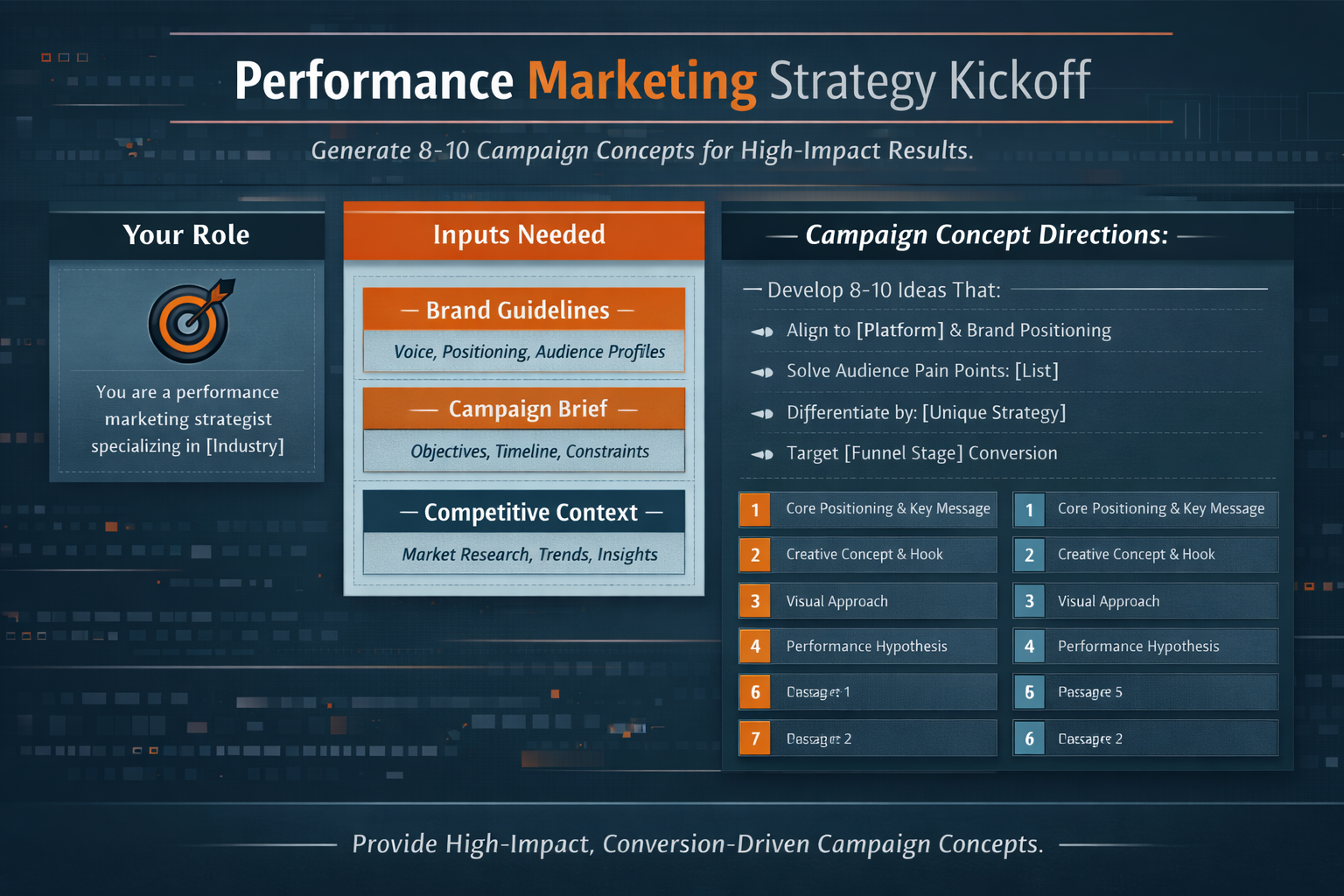
What works: Strategic thinking, synthesizing complex inputs, generating diverse approaches
What doesn't: Making final creative decisions, understanding nuanced platform trends without current data, knowing our specific client's historical performance patterns (we provide that context)
Copywriting and Messaging
Primary Tools: Claude for long-form and strategic copy, ChatGPT for volume variation generation
How we use it:
Generate hook variations exploring different angles
Develop body copy aligned to concepts and brand voice
Create CTA variations optimized for different funnel stages
Adapt copy across platforms while maintaining core messaging
Critical Process Element: Brand Voice Calibration
We don't just feed prompts to AI and use the output. We've developed brand-specific voice profiles for each client that include:
10-15 examples of approved copy representing the brand voice
Specific language to avoid (clichés, overused phrases, off-brand terminology)
Tone parameters (conversational vs. professional, playful vs. serious, technical vs. accessible)
Messaging frameworks and value proposition hierarchies
Example workflow:
AI generates 30 hook variations for a concept
Creative director reviews and selects 8-10 that are strategically on-target
CD provides specific feedback on voice, tone, or strategic refinement needs
AI regenerates variations incorporating feedback
CD makes final polish and approval
Time savings: 6-8 hours per campaign Quality difference: Negligible when properly calibrated, sometimes better due to volume enabling better selection
Visual Concept Development
Primary Tools: Midjourney for conceptual exploration, DALL-E for specific executions, Adobe Firefly for brand-safe applications
How we use it:
Generate visual concept explorations during early creative development
Create custom imagery when photography isn't available or budget-appropriate
Develop background elements and supporting visual assets
Produce platform-specific adaptations of core creative
Critical Constraints:
We do not use AI-generated images for:
Luxury fashion brands where photography is part of the brand equity
Any client where product accuracy is critical (exact product representation)
Primary hero images in high-stakes campaigns
Anywhere human photography would be expected by the audience
We do use AI-generated images for:
Conceptual explorations in early strategy phases
Background elements and supporting visuals
Social content where illustration style is appropriate
Rapid variation testing to validate concepts before investing in photography
Categories where illustrated or graphic styles are on-brand
Example application: For a Web3 client, we used AI-generated abstract visualizations representing concepts like "decentralization" and "digital ownership" that would be nearly impossible to photograph. The AI-generated visuals perfectly served the need, and we were transparent with the client about the approach.
Video Production and Editing
Primary Tools: Descript for editing and transcription, Runway for AI effects and enhancements, Adobe Premiere with AI-assisted features
How we use it:
Automated transcription and subtitle generation
AI-assisted rough cuts based on script structure
Background replacement and environment modification
Visual effects and enhancements
Automated platform-specific formatting (9:16 vs 16:9 vs 1:1)
Where this saves the most time: Mechanical editing tasks like trimming silence, generating captions, creating platform-specific aspect ratios. These tasks used to consume 30-40% of video production time.
What still requires human expertise: Creative direction, pacing and flow decisions, color grading, final polish, ensuring brand alignment.
Platform Adaptation and Optimization
Primary Tools: Custom automation scripts using Make.com and ChatGPT API, Adobe Express for bulk resizing
How we use it:
Automatically generate platform-specific sizes from master creative (Meta, Google, TikTok, Pinterest specs)
Create file naming conventions and organization systems
Generate performance prediction scores for variations
Optimize file sizes for platform requirements
Time savings: 4-6 hours per campaign on purely mechanical adaptation work
The Transparency Strategy: Why We Tell Clients About AI
Here's a decision that separated us from competitors: we decided to be completely transparent about our AI usage rather than hiding it.
Many agencies quietly use AI and never mention it. We do the opposite. We proactively tell clients about our AI-enhanced workflows, explain exactly how we use AI and where human expertise remains essential, and position it as a competitive advantage.
Why transparency works:
1. It Builds Trust
When clients discover agencies are using AI without disclosure, it erodes trust. They wonder what else isn't being disclosed. By being upfront, we establish ourselves as honest partners.
2. It Justifies Our Value
By clearly articulating which work AI handles versus which work requires our specific expertise, we help clients understand what they're paying for. They're not paying for the mechanical execution, they're paying for strategic thinking, creative direction, brand expertise, and optimization knowledge.
3. It Differentiates Us
Many agencies are either AI-skeptical or secretly AI-dependent. We're openly AI-enhanced while maintaining strong human oversight. This positions us as forward-thinking but not reckless.
4. It Enables Better Pricing
By reducing production costs 60-70%, we can either:
Offer more competitive pricing and win more business
Maintain pricing and dramatically improve margins
Maintain pricing and redirect savings to higher creative volumes and better results
We generally do option 3: clients pay similar rates but get 2-3x the creative output and better performance results.
Client Reactions:
Initially we worried about negative reactions. Instead:
87% of clients responded positively when we explained the approach
12% were neutral ("whatever delivers results")
Only 1% expressed concerns, which we addressed by showing before/after quality comparisons
Several clients specifically chose to work with us because of our AI capabilities, viewing it as getting access to cutting-edge methodology.
The Human-AI Collaboration Framework
The key to our success wasn't the AI tools, it was developing a clear framework for when to use AI versus when human expertise is essential.
AI Handles:
Volume variation generation
Mechanical adaptation (sizes, formats, platforms)
Synthesis of large data sets or research
First-draft concept exploration
Repetitive execution tasks
Consistency checking against guidelines
Humans Handle:
Strategic direction and creative briefing
Final creative decisions and approval
Brand voice calibration and quality assessment
Client communication and relationship management
Nuanced platform and industry expertise
Performance analysis and optimization strategy
Anything requiring genuine taste, judgment, or creative intuition
Collaboration Zone (AI + Human Together):
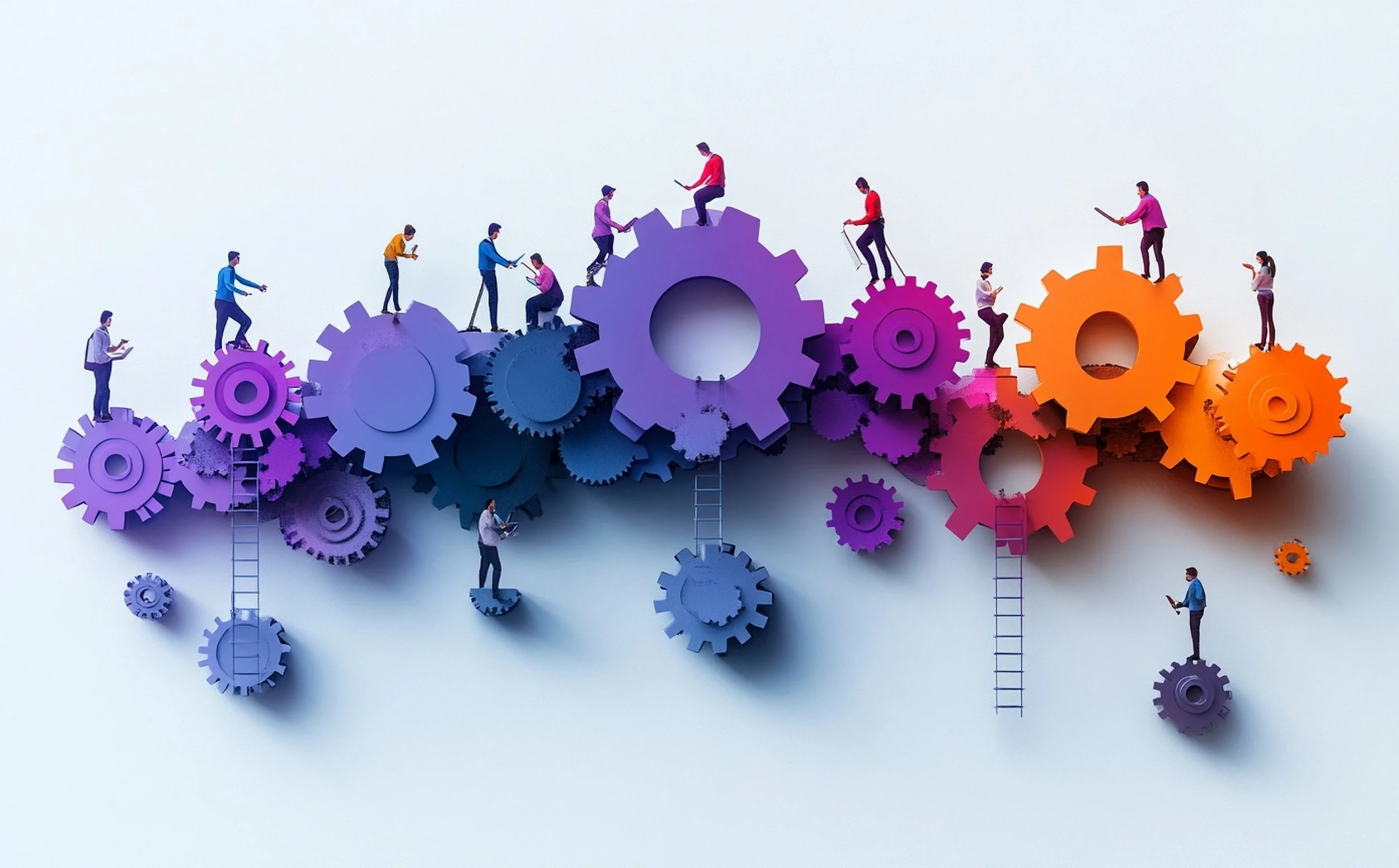
Concept development (AI generates options, human refines and selects)
Copywriting (AI provides variations, human optimizes and polishes)
Visual exploration (AI explores territory, human directs and refines)
Data analysis (AI processes data, human interprets and strategizes)
What Didn't Work: AI Limitations We Discovered
Transparency means sharing failures, not just wins. Here's what we learned AI can't do well (yet):
1. Understanding Nuanced Brand Voice Without Extensive Training
Early on, we tried using AI for client copywriting without thorough brand voice calibration. The results were generically good but specifically wrong, the copy was well-written but didn't sound like the brand.
Solution: We now invest 2-3 hours per new client developing comprehensive brand voice profiles with examples, parameters, and feedback loops before any AI copywriting.
2. Making Strategic Trade-Off Decisions
AI can generate options but struggles with strategic prioritization when trade-offs exist. Should we prioritize brand building or conversion? Premium positioning or accessibility? AI will give you both; humans have to choose.
Solution: Humans own all strategic decision points. AI informs decisions but doesn't make them.
3. Knowing What's Currently Trending on Platforms
AI training data has cutoff dates. It doesn't know what's working on Meta ads this week or what creative trends are emerging on TikTok today.
Solution: Human team members actively research platforms and feed current insights into AI prompts to ground recommendations in current reality.
4. Understanding Client-Specific Historical Performance
AI doesn't automatically know that this particular client's audience responds better to testimonial-style creative than lifestyle imagery, or that their Instagram campaigns outperform Facebook despite conventional wisdom.
Solution: We manually input client performance history and patterns into AI context when relevant.
5. Maintaining Multi-Turn Creative Consistency
When developing creative through multiple revision rounds, AI sometimes "forgets" earlier decisions or drifts from the established direction.
Solution: Humans maintain creative continuity across iteration cycles and redirect AI when drift occurs.
The Results: Performance Metrics That Matter
Let me share specific performance comparisons from our first six months of AI-enhanced workflows:
Production Efficiency:
Creative production time: 58% reduction
Creative team capacity: 2.8x increase (same team, more output)
Production costs: 65% reduction
Client revision cycles: 47% decrease
Creative Performance:
Average CTR: 23% improvement (AI-enhanced vs. previous benchmarks)
Average CPA: 31% improvement
Creative testing velocity: 3.2x faster identification of winning concepts
Creative variation volume: 2.1x increase in variations per campaign
Client Outcomes:
Campaign launch timelines: 62% faster
Client satisfaction scores: 18% increase
Client retention: 34% improvement
Referral rate: 41% increase
Business Impact:
Revenue per team member: 94% increase
Profit margin: 27 percentage point improvement
Client capacity: Able to serve 2.3x more clients with same team size
These aren't hypothetical benefits, they're measured outcomes from actual client work.
How Other Agencies Can Implement AI (Without Burning Everything Down)
If you're running an agency and want to capture similar benefits, here's my recommended implementation approach:
Phase 1: Pilot on Internal Projects (Weeks 1-4)
Don't start with client work. Start with internal projects where mistakes don't matter:
Your own agency marketing content
Internal process documentation
Non-critical client deliverables (social content, blog posts)
Objectives:
Learn tool capabilities and limitations
Develop effective prompting strategies
Identify where AI adds value versus where it struggles
Build confidence before client deployment
Phase 2: Controlled Client Testing (Weeks 5-8)
Select 2-3 clients with:
Strong existing relationships and trust
Less time-sensitive projects
Openness to innovation
Approach:
Fully disclose AI testing
Run parallel workflows (traditional + AI-enhanced)
Compare quality and efficiency
Gather client feedback
Phase 3: Standard Workflow Integration (Weeks 9-16)
Gradually shift standard workflows to AI-enhanced approaches:
Start with lowest-risk applications (research, first drafts, mechanical tasks)
Develop brand-specific calibration for each client
Train team on effective AI collaboration
Create quality control checkpoints
Phase 4: Optimization and Scaling (Weeks 17+)
Refine and expand AI integration:
Develop custom prompts and workflows for common tasks
Build brand voice libraries for faster calibration
Identify opportunities for custom automation
Scale successes across all clients
Critical Success Factors:
1. Team Buy-In Your creative team needs to understand that AI enhances their work, not threatens their jobs. Frame it as eliminating grunt work so they can focus on high-value creative thinking.
2. Quality Standards AI-enhanced doesn't mean lower quality. Maintain the same approval standards—AI output should meet the same benchmarks as human-created work.
3. Client Communication Be transparent. Explain your approach, emphasize the value of human expertise, and position AI as an efficiency tool.
4. Continuous Learning AI tools evolve rapidly. Dedicate time weekly to exploring new capabilities, tools, and approaches.
The Future: Where This Goes Next
We're currently exploring several advanced AI applications:
AI-Powered Performance Prediction: Training models on our historical creative performance data to predict which new creative variations will perform best before launch. Early testing shows 67% accuracy in predicting top-quartile performers.
Custom Client AI Instances: Building brand-specific AI instances pre-trained on each client's brand guidelines, historical creative, audience data, and performance patterns. This would enable even faster production with higher quality output.
Automated Optimization: Connecting AI to campaign performance data to automatically suggest creative refinements based on real performance metrics. Not automated execution, but AI-recommended optimizations for human review.
AI-Enhanced Attribution: Using AI to analyze complex customer journey data and improve attribution modeling accuracy. This could dramatically improve budget allocation decisions.
The Bottom Line: AI as Acceleration, Not Replacement
The agencies that will win in the AI era aren't the ones that replace humans with AI. They're the ones that effectively combine AI efficiency with human expertise and judgment.
AI has made our creative production 60% faster. But what really matters is that it made our creative better—more volume enables better testing, saved time gets redirected to iteration and refinement, and our team focuses on the high-value work that actually differentiates our output.
For clients, the benefits are clear: faster turnarounds, more creative variations, better performance results, and more strategic thinking from our team because we're not buried in mechanical execution work.
For our team, the benefits are even better: less time on grunt work, more time on creative thinking, ability to serve more clients without burnout, and competitive advantage in the market.
This is what AI-accelerated marketing looks like when done right: humans empowered by AI, not replaced by it.
Want to see how AI-enhanced creative production could transform your marketing results? We offer comprehensive creative audits that identify opportunities for AI acceleration while maintaining quality standards. Contact us to discuss your creative production challenges.
Claudia Giraldo Creative is a full-stack marketing and creative agency specializing in AI-enhanced performance marketing for fashion, e-commerce, SaaS, and Web3 brands. We combine cutting-edge AI tools with luxury fashion storytelling expertise to deliver superior creative at unprecedented speed.